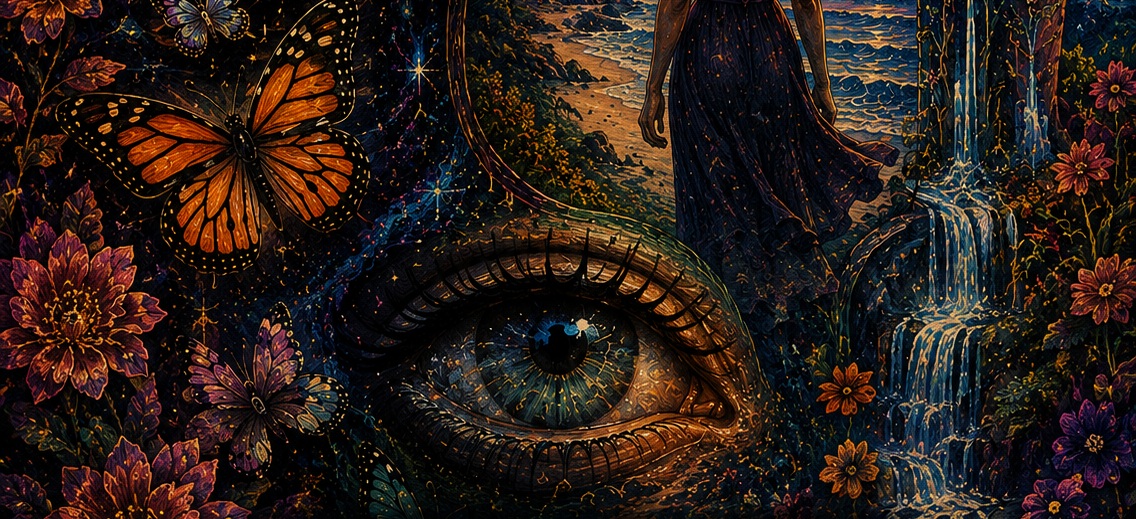
Há livros que se leem; há livros que se habitam. Caleidoscópio de Eros pertence à segunda estirpe: não oferece um enredo, mas um território — movediço, íntimo, muitas vezes dilacerado — onde prazer, solidão e anseio pelo divino se fundem numa só matéria incandescente. Arthur Silva Sacramento não nos conduz por paisagens nítidas nem nos apresenta personagens com nome e rosto. Em vez disso, convida-nos a girar o tubo de um caleidoscópio emocional, onde cada fragmento de texto reflete uma centelha da sua experiência interior: o desejo que se acende na mais absoluta solitude, a beleza que irrompe na ferida, a fé que persiste quando todos os espelhos parecem vazios.
A obra propõe-se como uma "compilação de textos" — mas seria mais justo chamá-la de uma anatomia lírica da alma solitária e desejante. O autor revisita obsessivamente os mesmos motivos: a virgindade como estigma e como portal, o corpo feminino como revelação e abismo, a linguagem como armadilha e como última tábua de salvação. E o faz num estilo fragmentário, sem avisos, sem transições suaves, porque o que se narra aqui não é a cronologia de uma vida, mas a topografia de uma consciência em transe.
Há ecos de Nietzsche e Schopenhauer, mas também de uma mística muito própria, em que o sexo se torna sacramento. "O que acontece antes do ato é mais importante do que o próprio ato", escreve ele — nessa afirmação condensa uma filosofia inteira.
O leitor fará bem em abandonar qualquer expectativa de conforto. Aqui não se oferece consolo fácil, mas uma companhia rara: a de uma voz que transforma a mais funda miséria em beleza, e que, mesmo no seu canto mais escuro, nunca deixa de procurar um feixe de luz.
There are books we read; there are books we inhabit. Eros's Kaleidoscope belongs to the second kind: it offers not a plot, but a territory — shifting, intimate, often lacerated — where pleasure, solitude, and the yearning for the divine fuse into a single incandescent substance. Arthur Silva Sacramento does not lead us through clear landscapes or introduce us to characters with names and faces. Instead, he invites us to twist the tube of an emotional kaleidoscope, in which each fragment of text reflects a spark of his inner experience: desire that flares up in the most absolute solitude, beauty that breaks through the wound, faith that persists when all mirrors seem empty.
The work presents itself as a "compilation of texts" — but it would be fairer to call it a lyrical anatomy of the solitary and longing soul. The author obsessively revisits the same motifs: virginity as stigma and as portal, the female body as revelation and abyss, language as a trap and as a last plank of salvation. And he does so in a fragmented style, without warning, without smooth transitions, because what is narrated here is not the chronology of a life, but the topography of a consciousness in trance.
There are echoes of Nietzsche and Schopenhauer, but also of a very personal mysticism, in which sex becomes sacrament. "What happens before the act is more important than the act itself," he writes — in that statement he condenses an entire philosophy.
The reader would do well to abandon any expectation of comfort. Here no easy consolation is offered, but a rare companionship: that of a voice that transforms the deepest misery into beauty, and that, even in its darkest corner, never stops searching for a beam of light.